Scaling AI Conversational Sales to $25K+/Day
Architecting an autonomous sales and dispatch platform
for North American home services — from initial concept through commercial rollout.
Only a small fraction of the platform's solutions is shown here — core workflows and real data remain confidential.
NDAContext & Problem
When I joined the project as Senior Designer, the platform existed only as a vision and raw developer prototypes. Home service operators—predominantly in the pest control and lawn care sectors across North America—faced a severe business paradox: 80% of their future profit sat dormant within existing customer accounts, but over 62% of customer churn occurred simply because customers felt neglected.
Contractors were burdened by peak-season operations and lacked the human bandwidth to perform outbound calls, follow up on dormant leads, or cross-sell seasonal treatments like mosquito prevention. At the same time, earlier attempts to automate outreach suffered from brittle API integrations with conservative industry CRMs (FieldRoutes, PestPac) and a fragmented onboarding experience that took several days to configure.
Transform crude developer prototypes into an enterprise-grade AI operations suite that business owners could trust with direct customer conversations.
As a Senior Product Designer, I spent nearly two years spearheading the product architecture from early discovery through full commercial launch. Working embedded with the CEO, CTO, AI/ML engineers, frontend teams, and customer support specialists, I designed the comprehensive system: onboarding, audience segmentation, campaign orchestration, two-way conversational inbox, and a modular design system.
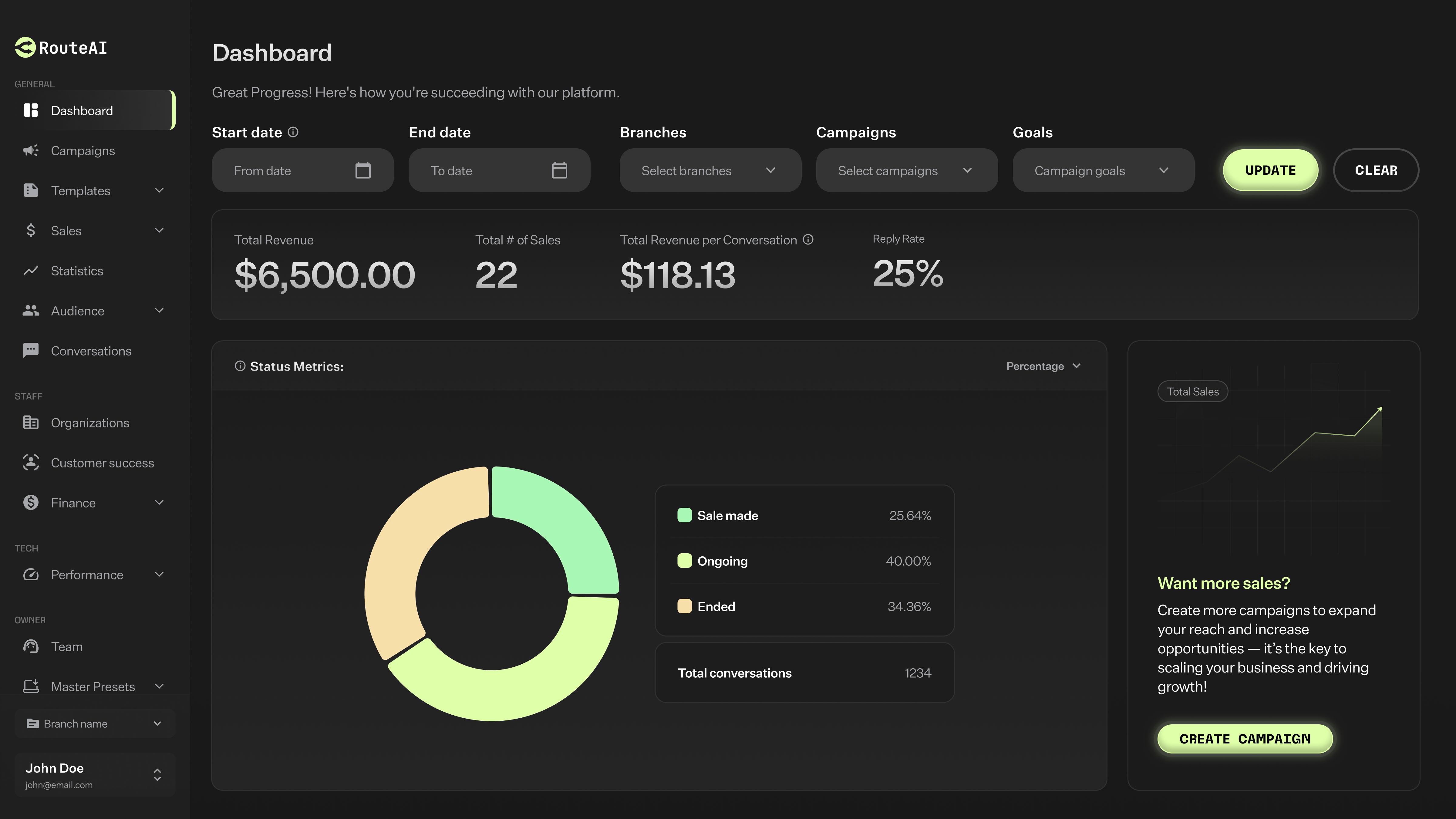
Executive performance dashboard tracking revenue per conversation, status metrics, and sales conversion velocity.
Onboarding
The single biggest leak in the business funnel was the initial setup. Before the redesign, onboarding was an opaque, multi-day ordeal: operators had to manually exchange API keys, configure telephony, and navigate complex carrier verification without any sense of progress. If a user left the browser mid-setup, their state was lost, causing massive drop-offs before a single campaign could ever launch.
I re-architected the activation journey into a predictable, multi-step onboarding wizard centered around three core foundations:
- Session Persistence: Visual progress tracking with state recovery, allowing operators to pause and resume onboarding without losing setup progress.
- Telephony Provisioning: Direct Twilio integration to register and verify local A2P-compliant phone numbers without leaving the onboarding flow.
- CRM Integrations: Single-session OAuth connections for FieldRoutes, PestPac, and RealGreen with real-time sync validation.
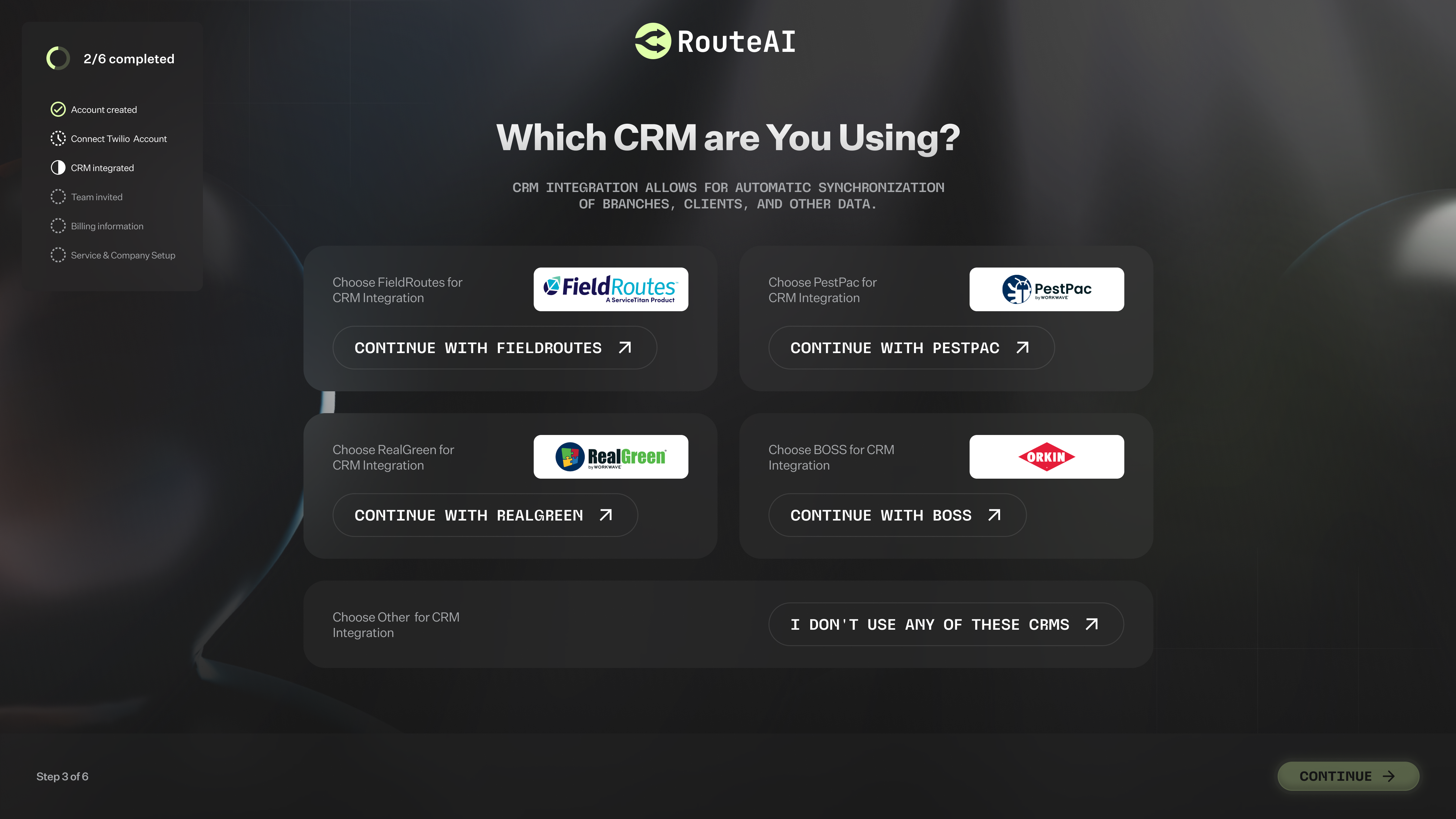
Step-by-step CRM selector supporting automated data synchronization for legacy industry providers.
However, the biggest catalyst for compressing setup time was introducing conversational AI onboarding. Instead of forcing busy business owners to manually fill out dozens of tedious configuration forms, pricing tables, and service specifications, operators could simply drop their existing price sheets or policy documents into the platform.
An embedded AI Setup Assistant parses the raw documents in seconds, extracts the core catalog structure, and guides the operator through an intuitive conversational chat. Through single-click suggestion chips, the assistant confirms service scopes, verifies pricing bounds, and establishes targeting strategies—turning what previously took days of tedious back-and-forth into a 3-minute conversational setup.
This conversational breakthrough was the single most pivotal operational catalyst: by eliminating the multi-day configuration barrier, onboarding completion tripled from 18% to 54%, empowering new clients to launch revenue-generating campaigns on Day 1 rather than abandoning during sales setup.
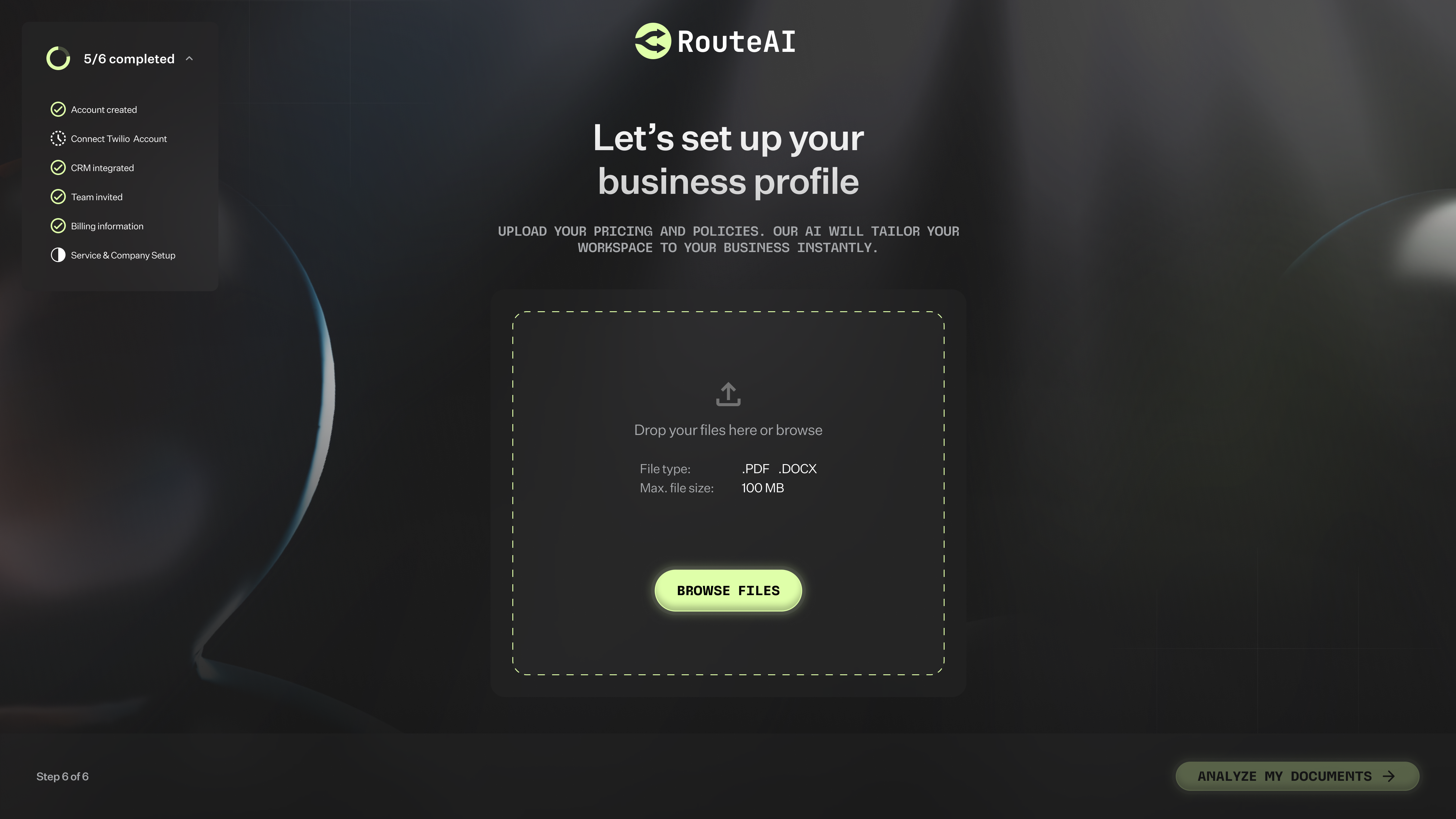
Document dropzone for instant AI parsing of service rates, treatment scopes, and company policies.
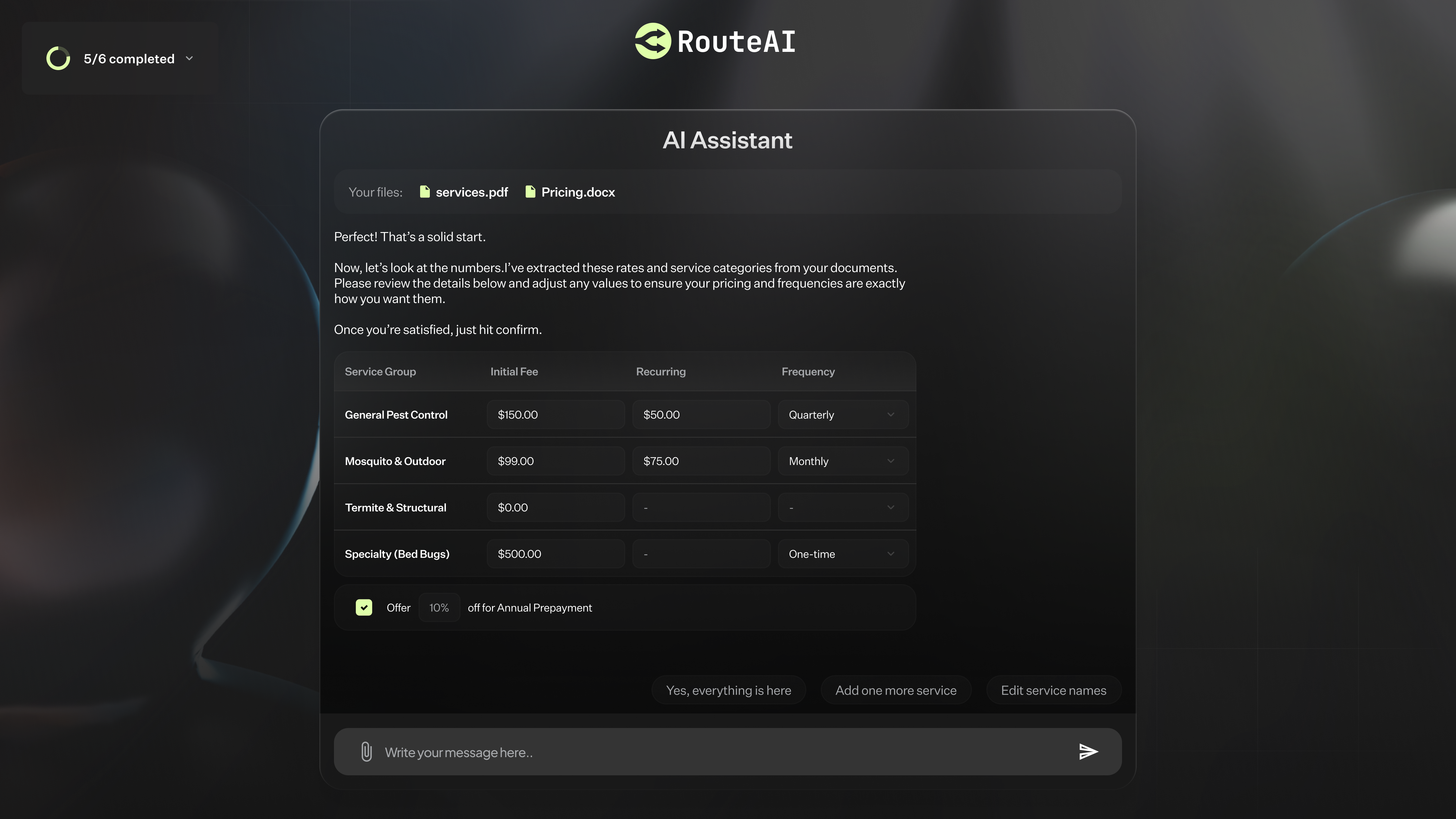
Conversational AI assistant reviewing parsed service tiers with one-tap suggestion chips.
Campaign Engine
The original campaign creation flow was rigid, linear, and required fully structured CRM databases. In reality, many target business owners still managed customer contacts through raw spreadsheets or legacy exports. Forcing a strict CRM dependency caused high abandonment during the sales cycle.
With Campaign Engine V2, I introduced a flexible dual-track architecture:
- Event-Driven Triggers: CRM-connected automations that listen to real-time service events to trigger seasonal upsells, win-backs, and appointment reminders.
- CSV & Spreadsheet Ingestion: Flexible audience import for operators without advanced CRMs, featuring automatic column mapping and deduplication.
- Guardrails & Verification: Multi-tier review workflow ensuring campaigns pass staff review and customer approval, with strict pricing bounds and forbidden phrase filters.
To protect client reputation, business owners could fine-tune their sales guidelines directly in the interface—establishing strict price bounds, setting prohibited phrases, and previewing simulated conversation threads before launching.
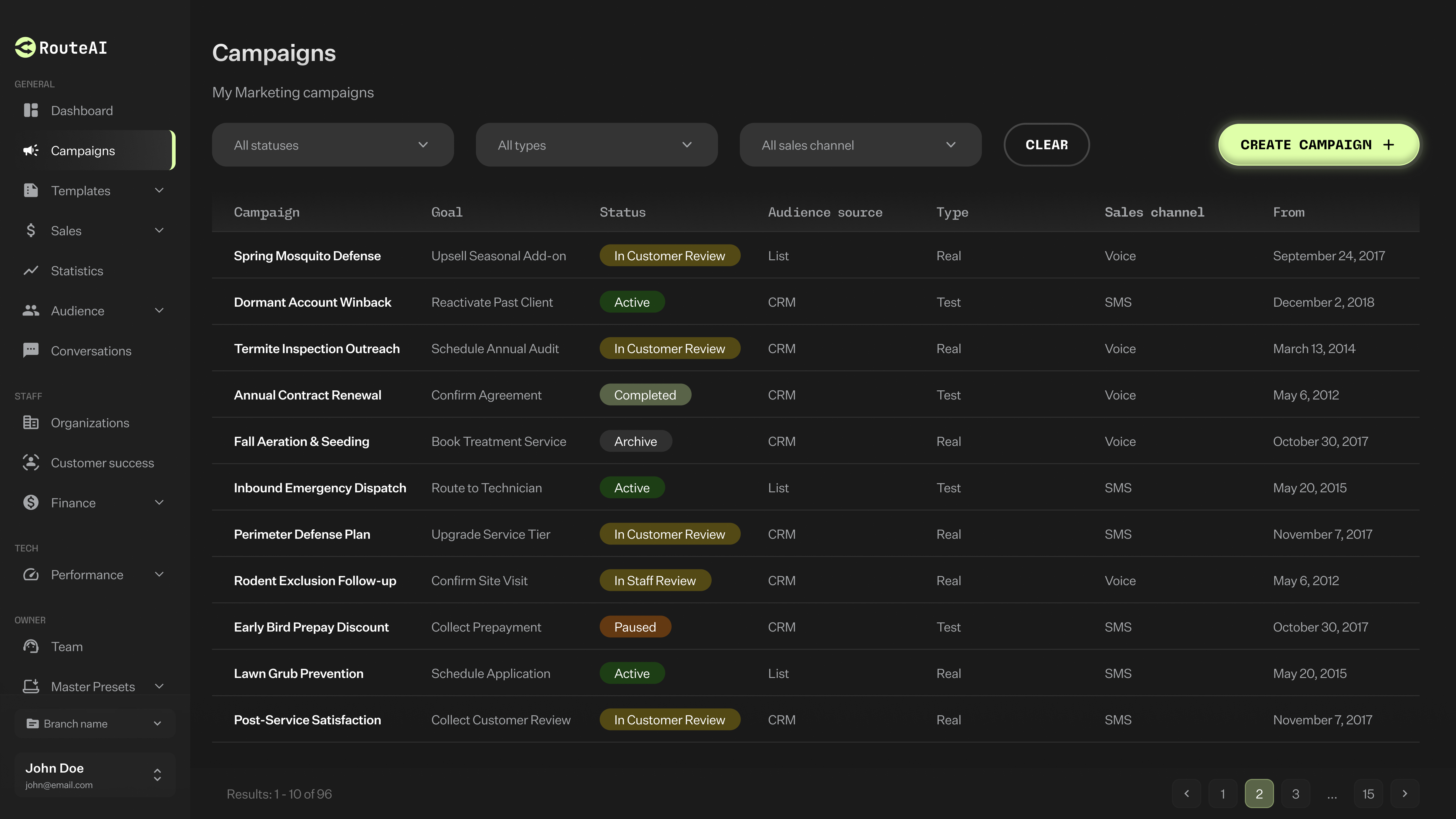
Campaign operations table managing voice and SMS pipelines across CRM audiences and custom lists.
Conversations & AI
Pest control is a relationship-heavy business where a robotic response can alienate long-time clients. Business owners had reasonable anxiety about whether an AI model might hallucinate, promise unauthorized services, or quote the wrong pricing.
To build trust in autonomous messaging, the conversations hub was designed around radical transparency and instant human control:
- Dev Mode Transparency: Live timeline badges for raw LLM execution calls, detected customer intent, and CRM property changes.
- Instant Human Takeover: Single-click override allowing operators to pause AI and step into any chat with preserved context and thread history.
- Revenue Attribution: Transparent tracking attributing closed deals and service bookings directly to specific conversations.
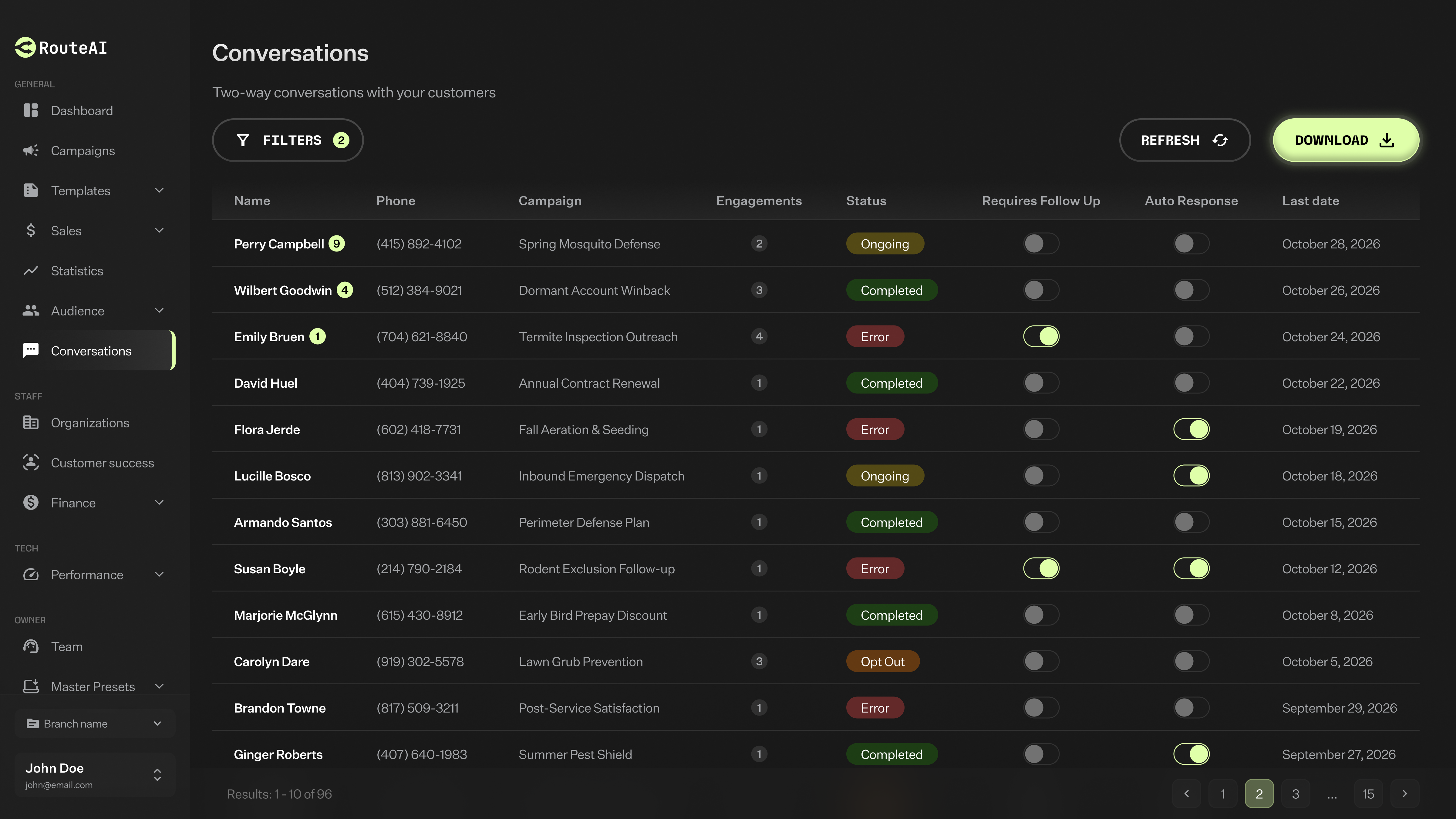
Two-way conversation directory featuring automated response controls and manual follow-up flags.
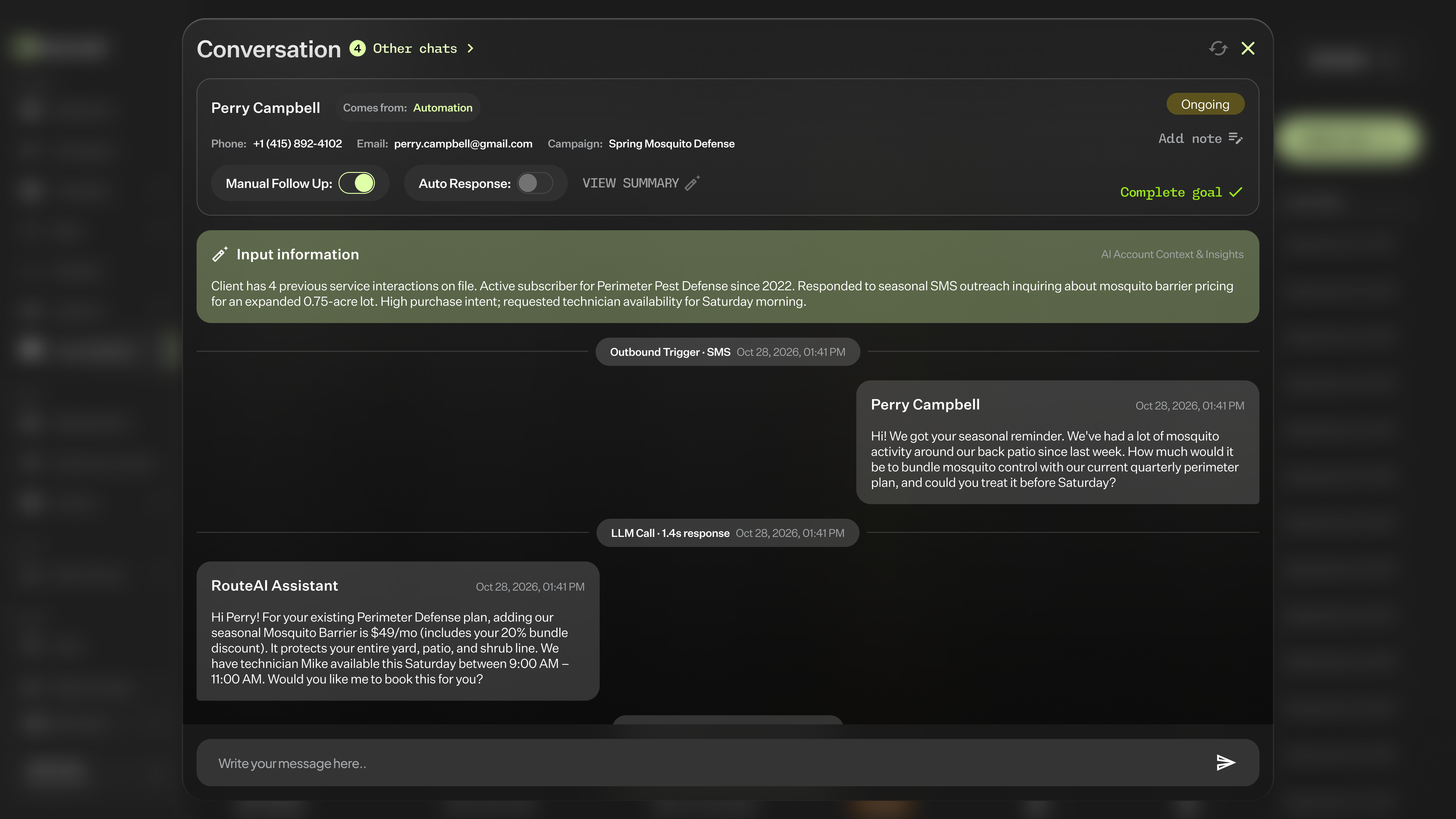
Live customer thread modal with CRM context summary, autonomous LLM execution tags, and manual takeover.
Conversion Funnel & Analytics
Business owners don't just care about the volume of messages dispatched — they need clear unit economics: what did each conversation cost, where do leads drop off, and how much actual revenue was generated.
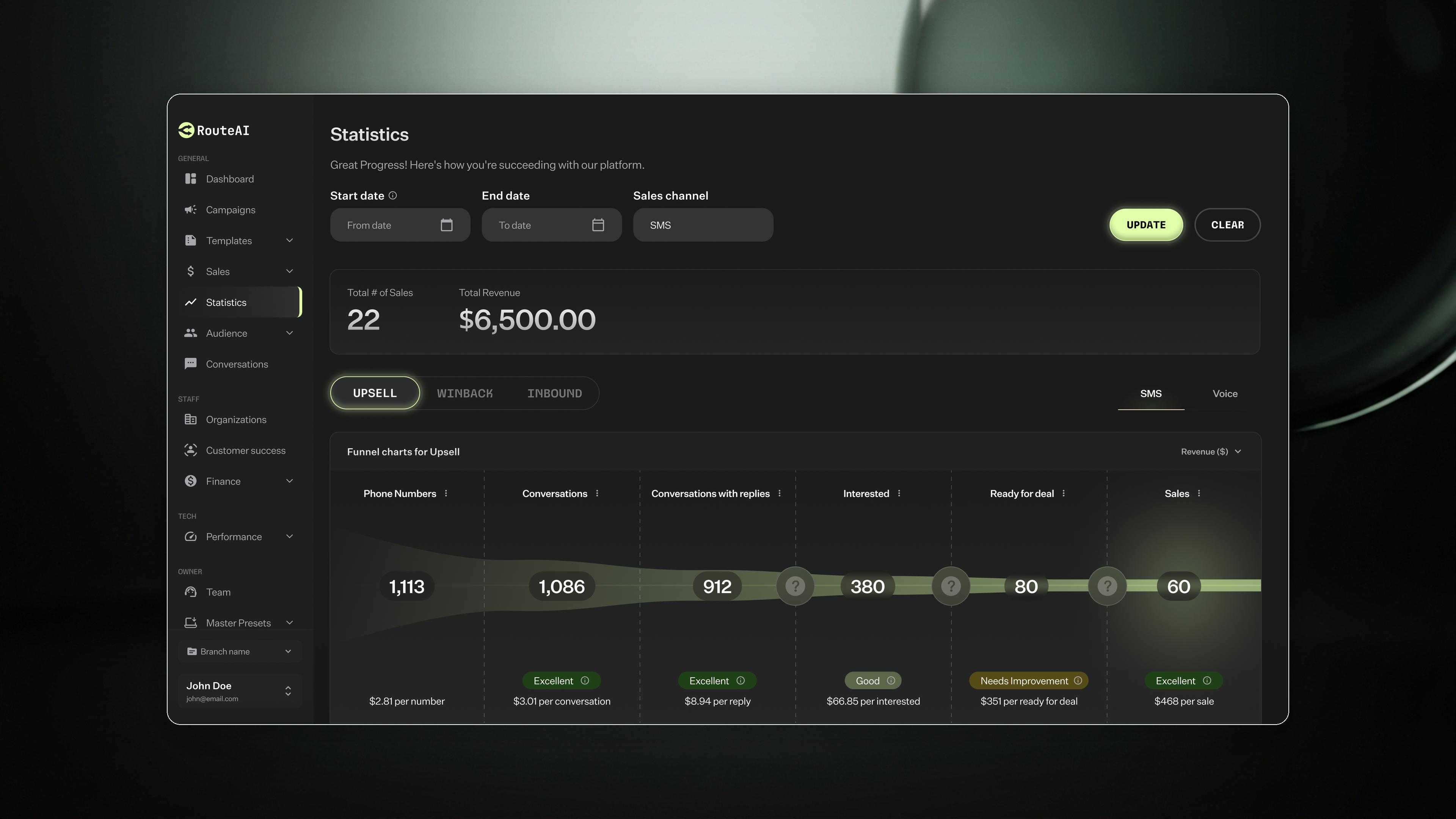
I designed an interactive conversion funnel that maps the entire customer journey into distinct operational stages: from raw phone lists to recognized intents (Interested, Ready for deal) down to closed deals.
- Stage-by-Stage Unit Economics: The system automatically calculates real costs per milestone — from initial phone contact ($2.81) and meaningful reply ($8.94) to final closed sale ($468).
- Qualitative Health Benchmarks: Color-coded indicators (Excellent, Good, Needs Improvement) instantly surface conversion drop-offs so operators know when AI prompts or campaign criteria need refinement.
- Channel & Campaign Filtering: Rapid segmentation across campaign types (Upsell, Winback, Inbound) and delivery channels (SMS, Voice) to compare return on investment.
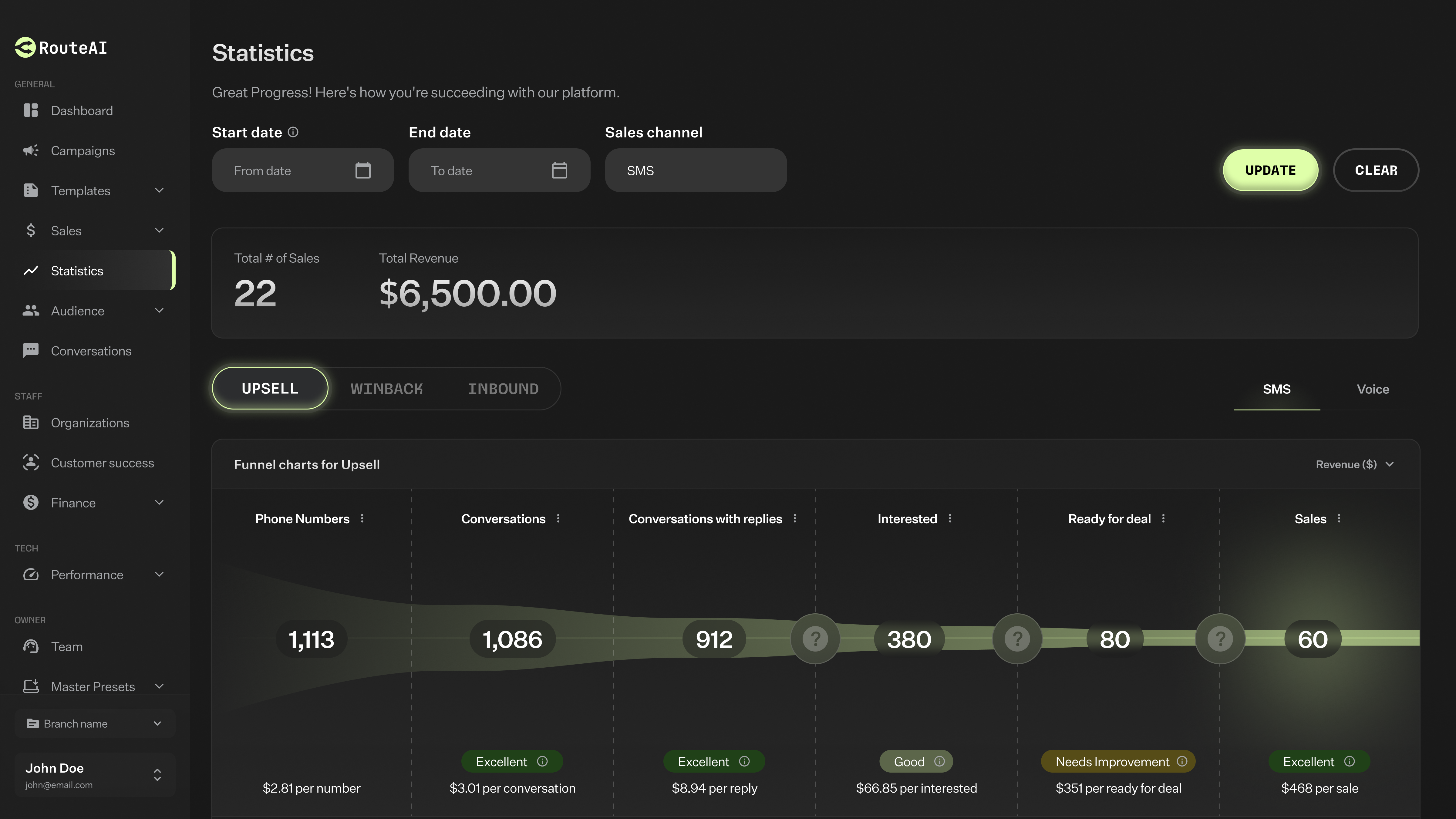
Interactive conversion funnel breaking down unit economics per stage with direct revenue attribution ($6,500).
Crucially, surfacing real-time conversion bottlenecks directly inside the funnel gave operators unprecedented tactical visibility into where leads stalled. Instead of guessing why prospects went dormant, teams could pinpoint friction points (such as pricing objections at the "Ready for deal" milestone), iterate AI prompts and targeting criteria within minutes, and systematically maximize campaign ROI. This direct link between transparent funnel diagnostics and agile campaign optimization became the primary growth engine unlocking over $25,000+/day in platform-generated revenue.
Multi-Branch Operations
Enterprise pest control operators rarely manage a single facility; they operate 10 to 30 regional branches across different states. Each branch features entirely distinct pricing models, state chemical regulations, and localized service offerings.
To support this operational reality, I architected a hierarchical organization and branch system. We resolved critical UX edge cases such as cross-tab browser desynchronization: if a manager altered the active branch in one tab while launching a regional campaign in another, the system automatically locked the campaign builder and displayed non-destructive modal warnings, eliminating accidental cross-state data contamination.
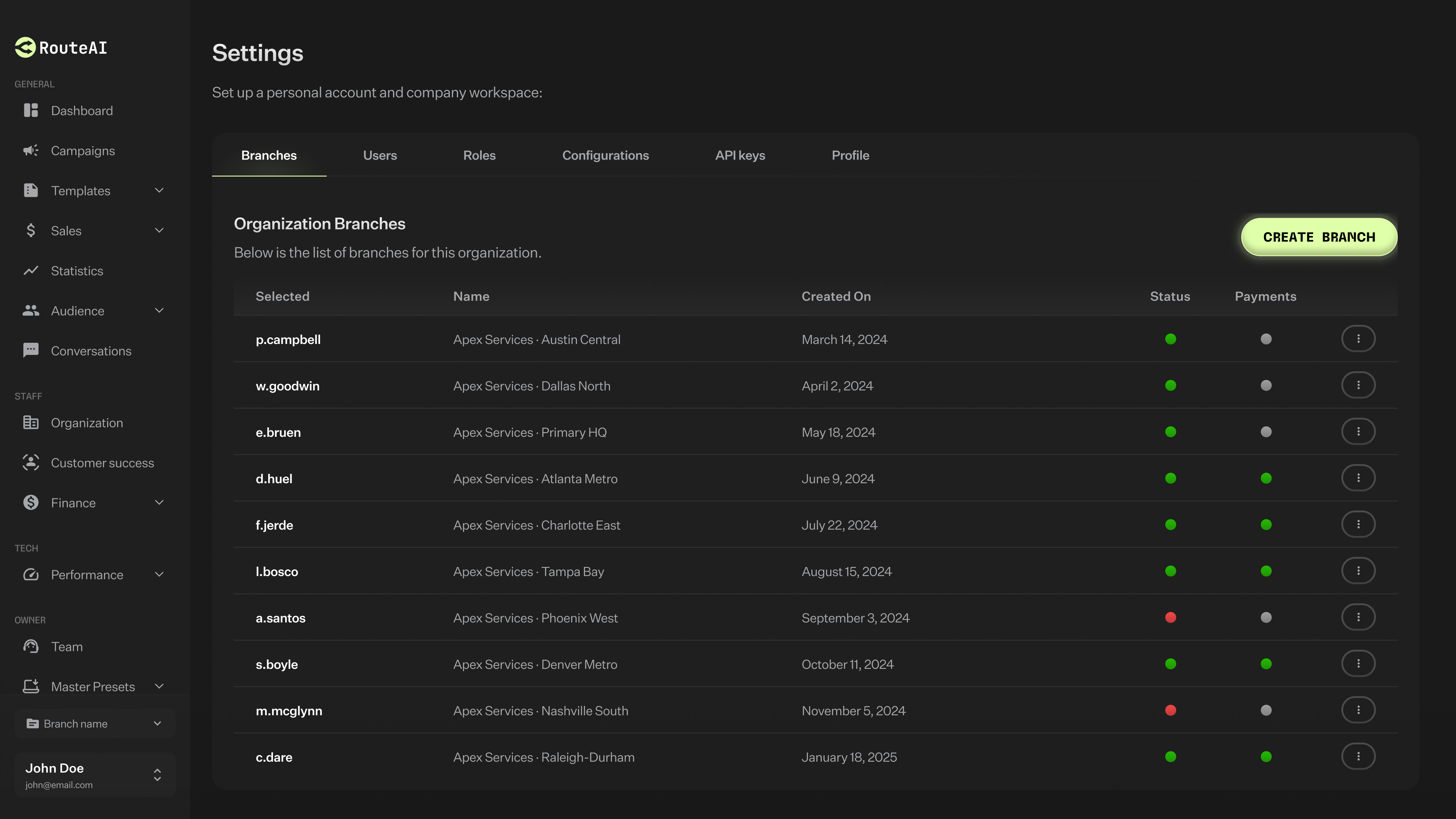
Organization branch registry supporting multi-location routing, localized pricing, and payment states.
Design System
Building an enterprise platform spanning 260+ production views required a rigorous, accessible design system. I established UI Kit—a dense, tokenized component library tailored for data-heavy operations:
- High-Density Dark Theme: Optimized for long dispatch and CSR shifts, engineered with deep slates and high-contrast typography to reduce eye strain.
- Restrained Accent System: Focused lime tokens reserved strictly for active states, conversion alerts, and primary actions, maintaining strict interface utility.
- Tabular Data & Metrics: Monospace numeric figures for precise financial reconciliation paired with refined typography for comfortable, sustained reading.
- Reusable Enterprise Patterns: Standardized multi-tier data tables, live filters, empty states, and pagination controls.
Impact & Outcomes
By transforming a multi-day manual setup into an AI-assisted onboarding wizard, we slashed time-to-first-campaign from days to under 30 minutes, boosting completion by 3x. Paired with a real-time conversion funnel that visualizes drop-offs per stage, operators can instantly identify stalled leads and fine-tune AI prompts on the fly. This transparency empowered contractors to scale targeted campaigns with unprecedented efficiency, unlocking over $25,000+/day in platform revenue.
- $25,000+ / day in platform-generated revenue across active client deployments.
- 3x+ conversion: Tripled onboarding completion rate, turning a major drop-off point into a predictable growth funnel.
- From days to 30 minutes: Drastically compressed the time-to-first-campaign, enabling same-day campaign launches.
- Zero-Headcount Scaling: Self-serve setup allowed the team to scale client volume without adding support headcount.
- Call Center Savings: Autonomous SMS and voice agents handled repetitive inquiries, significantly reducing seasonal CSR overhead.
By designing a system where operators never felt out of control, we turned cautious business owners into enthusiastic advocates of autonomous AI workflows.
